
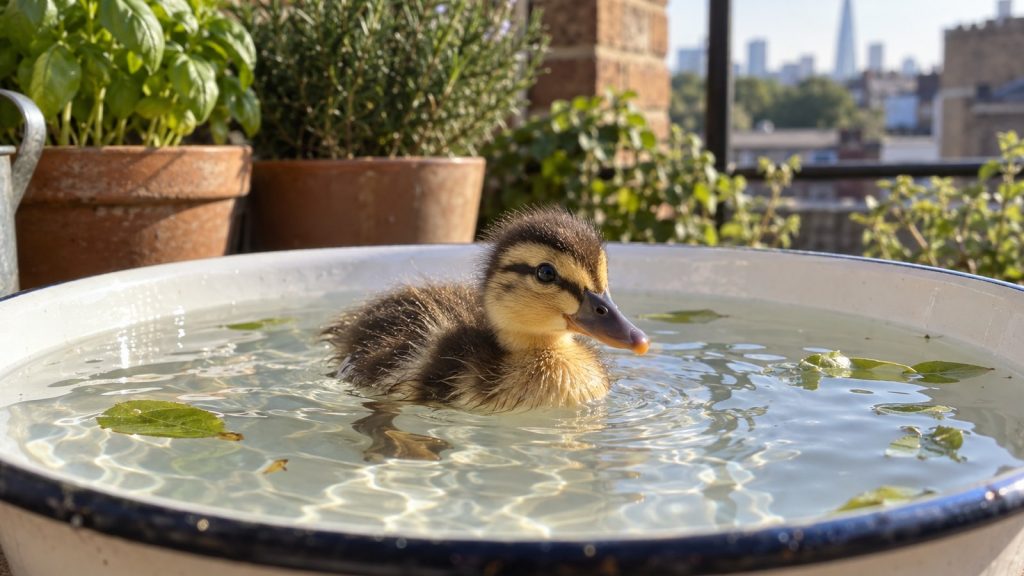
Most of us would walk right past an egg sitting alone in the dirt. Riyadh Khalaf picked his up and carried it across England in a paper cup. Then he spent 28 days watching it grow. What cracked out of that shell was a tiny mallard who went on to win over people around the world.
- An Irish broadcaster found a lone egg in Devon with no nest nearby and hatched it at home in London.
- He raised the duckling, Spike, with mirrors, a stuffed duck, and recorded duck sounds so he’d learn to act like a duck.
- Spike later joined a flock, and his fans raised over £11,000 to keep rescued ducks safe from bird flu.
An Egg Where No Egg Should Be
Riyadh Khalaf, an Irish author, broadcaster, and activist, was walking in Devon when he spotted a milky white egg in a pile of dirt, with no nest or other eggs nearby. He guessed it was a duck egg with little chance alone.
He tucked the egg into a paper cup lined with a napkin and brought it home to London, a trip of two car rides, a hotel stay, a train, the tube, and a bus.
He’d bred chickens and pigeons before and knew an egg can stay dormant for a while. So he ordered an incubator from Amazon to keep the egg at a steady temperature and humidity, as a mother bird would.
Twenty-Eight Days of Waiting
The changes came fast. Riyadh checked on the egg daily, spotting movement, then an eye, then the outline of a beak, and he started calling himself a duck dad.
On day 28, the shell cracked, revealing a small, round bill. It really was a duck.
Hatching can take up to 48 hours, and ducklings have to do it themselves. At 4:51 a.m., about 29 hours after the first crack, Riyadh woke to chirping. A wet little bird was staring back at him, and he said it was love at first sight.
He named the duckling Spike.
Teaching a Duckling to Be a Duck
Riyadh knew Spike would imprint on him somewhat, but Spike would one day need to live with other ducks. He didn’t want him thinking a human was his mom.
Spike’s setup, nicknamed Duckingham Palace, had mirrors so he could see what looked like another duckling, since ducklings can get badly stressed without other ducks around. A stuffed surrogate duck helped teach him to eat with his beak. Riyadh also used a duck whistle, hid his face at feeding time, and played duck sounds on his computer.
As Spike grew, he visited the park, paddled in a small bath, and learned to forage. Wild ducks mostly eat plants, small insects, seeds, grains, and fruit. Maine Audubon says bread gives them almost no nutrition and leaves less room for the food they actually need.
A Flock, a Fundraiser, and a Safe Place to Land
After 89 days, Spike moved to a rehabilitation center and joined a flock in an open-air facility, free to stay or leave once he could fly. Riyadh later shared video of Spike’s first flight.
In December 2024, the U.K. government told the center to keep its flock indoors because of a bird flu outbreak. Indoor housing isn’t cheap, so Riyadh turned to his followers, who raised more than £11,000 to help.
By June 2025, Spike was living with Leanne Clarke, who built a rescue shelter called The Quack Shack in her home with help from the fundraising. Riyadh shared that Spike seemed to remember him less and less. That was a little sad, but it meant Spike was doing well.
Before You Pick Up a Lonely Egg
Spike’s story is a sweet one, but it took a lot of know-how, time, and care. If you come across an egg that looks abandoned, think before you pick it up. Rules on wild bird eggs depend on where you live. In the U.S., most wild birds are protected under the Migratory Bird Treaty Act, and collecting their eggs or raising wild birds usually requires permits. A local wildlife rehabilitator can tell you whether the egg really needs help and who’s allowed to give it.
And if you just want something to make you smile, Riyadh’s videos of a damp little duckling meeting the world are hard to beat.
