
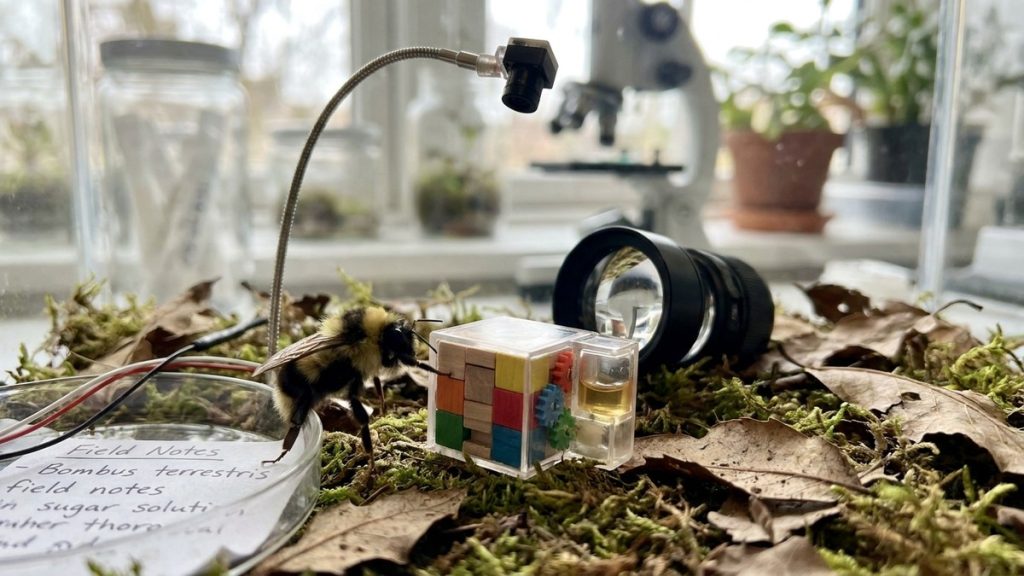
A handful of bumble bees just did something that left a team of Finnish researchers a little stunned. Faced with a reward they couldn’t reach, the bees invented their own fix on the spot, rolling a ball into place and climbing on top of it. Nobody trained them to do it. They simply worked it out.
- Bumble bees solved an object-moving puzzle they had never been taught, a task modeled on a classic chimpanzee experiment.
- The study appeared in the journal Science on June 4, 2026, led by researchers in Finland.
- Careful control tests ruled out luck, play, and trial-and-error, pointing to genuine goal-directed problem solving.
An Insect Take on the Box-and-Banana Test
More than a hundred years ago, psychologist Wolfgang Köhler ran a famous set of experiments with chimpanzees. He hung a banana out of reach and watched the apes stack boxes to climb up and grab it. Those moments became textbook examples of insight, the sudden flash where an animal combines objects in a fresh way to hit a goal. Readers interested in the broader context can also explore how researchers interpret animal behavior.
Researchers from the University of Oulu, the University of Helsinki, and the University of Turku wanted to know if a creature with a brain a tiny fraction of that size could pull off something similar. So they built an insect-sized version of the same challenge. The subjects were bumble bees, known to scientists as Bombus terrestris.
How the Puzzle Worked
First, the bees learned that a blue artificial flower held a sweet reward. Easy enough. Then the researchers moved that flower up to the ceiling of a clear arena, well beyond where any bee could land on it. The reward was right there in plain sight, but flat-out unreachable by normal means. For authoritative background, the Bumblebee Conservation Trust offers useful context.
The successful bees came up with a plan the scientists never showed them. They rolled a small ball underneath the flower, then climbed onto the ball to close the gap and get the treat. It was a two-step sequence, and it was entirely their own idea.
What makes that stand out is how little the bees knew going in. They had picked up just two separate lessons beforehand. One, the blue flower means food. Two, the ball is a harmless object that can be pushed around. Nobody ever linked those two facts for them. When the new problem showed up, many bees stitched their past experiences together into a solution that went well past anything they had practiced.
Ruling Out Dumb Luck
Smart-looking behavior can fool observers, so the team leaned hard on control experiments. They wanted to eliminate the boring explanations: accidental success, random ball-nudging, play, plain trial-and-error, or the bee simply steering toward something it could see.
In some of the tougher trials, the researchers hid the flower from view while the bees pushed the ball. That stripped away any visible target to aim at. Even without seeing the goal, plenty of bees still rolled the ball to the right spot. Lead author Akshaye Bhambore noted that the bees’ movements looked directed rather than aimless, with the strongest performers heading straight for the answer. Senior author Olli Loukola pointed out that the bees were fully naïve, with no prior history of using objects as tools, which sets this apart from earlier insect studies.
What a Tiny Brain Can Actually Do
Co-author Ece Nur Akmeşe described the strange rhythm of watching it happen. One second a bee wanders around with no clear purpose, and the next it fires off a tidy sequence of actions that lands it right at the reward. She called it genuinely fascinating to watch.
The team is careful about what the findings mean. They are not saying bees think like people or carry anything close to human awareness. Loukola put it plainly: the work shows that miniature brains can produce flexible answers to brand-new problems in ways we’re only starting to grasp. This kind of spontaneous, object-based problem solving has been studied almost entirely in vertebrates for over a century. The Finnish results hint that insects deserve a seat at that table too.
Why This Little Discovery Matters
It’s a good reminder that brain size isn’t the whole story. Bees already socially learn tool use, tackle puzzle boxes, cooperate, and adjust to shifting conditions. Adding on-the-fly invention to that list nudges us to rethink where the line for clever behavior really sits. Next time a bumble bee bumbles past your window, remember there’s more going on behind those big compound eyes than most of us ever gave it credit for.




More Stories
A Golden Retriever Tried to Make Friends With a Burglar
Terrier Rescued After Two Days in a Badger Sett
How a Star’s Gibbon Video Sparked a Wildlife Probe