
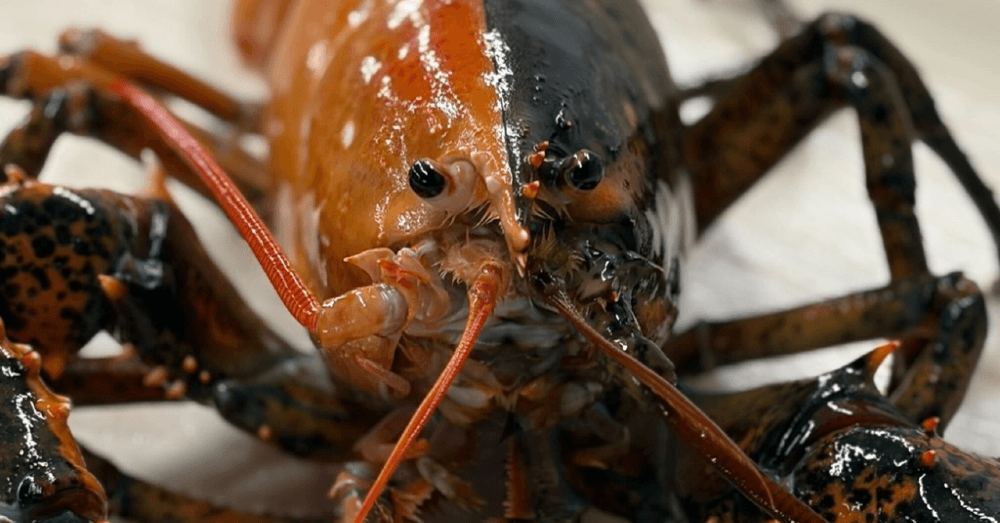
A fishing crew off Cape Cod hauled in a once-in-a-lifetime crustacean this April. The lobster was split right down the middle, half flame-orange and half mottled brown, with odds of about 1 in 50 million. Instead of ending up with melted butter on the side, this genetic oddity got a one-way ticket to a science aquarium.
- Caught April 16 by Wellfleet Shellfish Company aboard the Timothy Michael fishing vessel
- Weighs roughly 3 to 4 pounds, with a clean color line from antennae to tail fan
- Donated to Woods Hole Science Aquarium and currently housed at the Marine Biological Laboratory
A Catch You Don’t See Every Day
A lobster with a perfectly split shell in two different colors was caught off the coast of Cape Cod, Massachusetts, on Thursday, April 16. Wellfleet Shellfish Company shared news of the highly improbable find in a Facebook post on April 21. The Eastham-based company donated the rare beauty to the Woods Hole Science Aquarium, sparing it from any seafood pot.
The shell is divided evenly between orange-red and dark brown. The lobster weighs between three and four pounds, with a clean color split running from its antennae to its tail fan. Picture a lobster that looks like two different lobsters sharing one body, and you’ve pretty much got it.
Most American lobsters wear a drab green-brown coat that helps them disappear into the seafloor. That mottled palette lets them blend in and avoid being eaten by predators. By contrast, the split-color lobster’s bold pattern would have made it an easy target, so experts are a bit surprised it survived this long.
The Genetics Behind the Color Split
So how does a lobster end up looking like a Halloween costume? “When two eggs absorb one another, they develop into one animal with two different sets of genes,” aquarium biotechnician Julia Studley told the Cape Cod Times. The result is a chimera, an animal carrying two distinct genetic blueprints in a single body.
Studley also told Popular Science that split coloration happens when two fertilized, unlaid eggs contact each other, causing one to absorb the other. That creates a lobster with two sets of genetic information and the ability to store color pigments differently on either side of its shell.
The same biological quirk sometimes produces gynandromorphic animals, where one side of the body is male and the other female. In 2015, a half-male, half-female common archduke butterfly emerged from its chrysalis at the Academy of Natural Sciences of Drexel University. Three years later, a researcher identified a gynandromorphic sweat bee. And in 2021, ornithologists found a sex-split green honeycreeper.
From Boat Deck to Aquarium Tank
Once the crew realized what they had, they started making calls. Wellfleet Shellfish Company reached out to local aquariums to find a home where the public could see the lobster up close. They donated her to the Woods Hole Science Aquarium in Woods Hole, Massachusetts, which is owned and operated by NOAA Fisheries.
There’s a small twist, though. Woods Hole is undergoing renovations right now, so the lobster is being held at the Marine Biological Laboratory, a partner of the aquarium and NOAA Fisheries. She’s in a quarantine period to make sure she doesn’t carry any diseases, parasites, or illnesses that could spread to the aquarium’s other animals.
By all accounts, she’s doing really well. She’s settling in, eating, and staff are getting to know her personality. Her favorite food right now is live blue mussels.
How This Stacks Up Against Other Rare Lobsters
Lobsters with funky colors pop up now and then, but each level of rarity gets steeper. Last summer, a fisher caught a one-in-two-million blue lobster, later nicknamed Neptune, who was donated to Northeastern University’s Marine Science Center in Nahant, Massachusetts. Also last year, a fisher hauled in a 1-in-30-million calico lobster with a bright orange shell speckled with bits of black and blue. And in 2024, a fisherman caught a 1-in-100-million cotton candy lobster off the coast of New Castle, New Hampshire.
Albino lobsters, which don’t have any shell pigmentation, are the rarest in the ocean and show up in roughly 1 in 100 million lobsters, according to The American Oceans Campaign.
When Visitors Can See Her
Patience pays off if you want a peek at this two-tone celebrity. The nation’s oldest public aquarium will reopen in early 2027, giving visitors a close look at the unusual lobster. She’ll be one of the first animals going back into the aquarium once the doors swing open. Until then, she’s enjoying her mussel buffet in peace, a living reminder that genetics still has a few surprises left in the deep.




More Stories
A Golden Retriever Tried to Make Friends With a Burglar
Terrier Rescued After Two Days in a Badger Sett
How a Star’s Gibbon Video Sparked a Wildlife Probe