
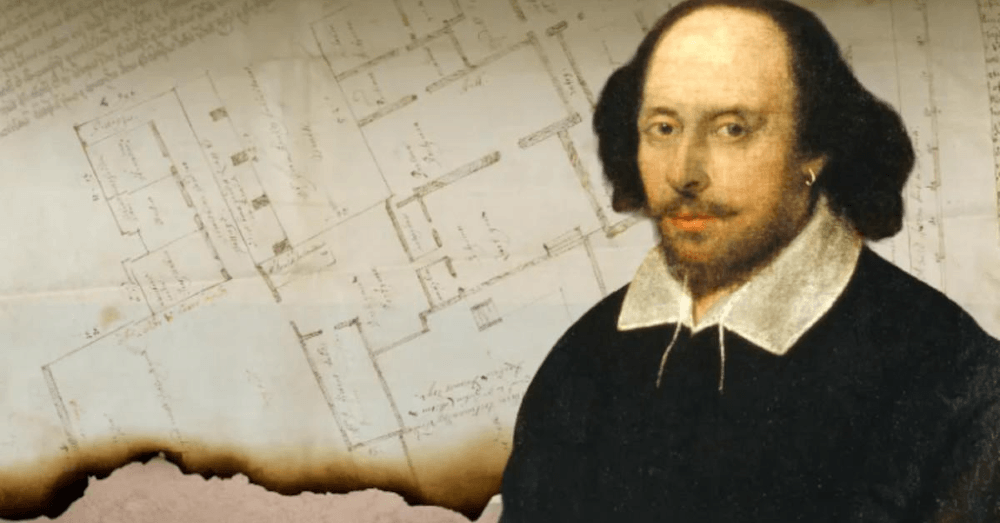
For more than three centuries, scholars squinted at old maps, traced deeds, and argued about one stubborn question. Where exactly did William Shakespeare live when he bought his one and only home in London? A professor combing through a dusty box of property records in a city archive just answered it, and the story reads like something straight out of a detective novel.
- A researcher at King’s College London found a 1668 floorplan that reveals the exact spot of Shakespeare’s Blackfriars house.
- The building was an L-shaped dwelling measuring 45 feet across, carved out of a former medieval friary.
- The find challenges the long-held story that the Bard quietly retired to Stratford after 1613.
A Chance Find in a Box of Old Deeds
Lucy Munro, a professor at King’s College London, had been studying the Blackfriars theater, the playhouse where Shakespeare’s acting company, the King’s Men, once performed, when she found the map in a box of centuries-old property deeds. She wasn’t hunting for Shakespeare’s house at all. As with so many discoveries, it was partly down to luck. “I came across it in the London Archives when I was looking for other things,” Munro said.
Munro noted there’s sometimes an assumption with Shakespeare biography that everything has been gone over again and again, when actually there are still pieces of the jigsaw puzzle out there. This piece turned out to be a big one.
What the Map Actually Shows
A plan of the Blackfriars precinct found by Munro shows in detail Shakespeare’s house, a substantial L-shaped dwelling carved from a former medieval monastery, including its gatehouse. The 13th-century Dominican friary had been redeveloped for more secular uses after the dissolution of the monasteries by King Henry VIII in the mid-16th century. The precinct included the Blackfriars playhouse, which Shakespeare part-owned.
The part of the property that spanned the gate does not appear in the post-fire plan because it had no foundation, but the other part measured 45 feet from east to west, 15 feet from north to south at the eastern end and 13 feet at the western end. That’s a serious footprint for central London. The plan doesn’t show its internal layout or rooms, but it was big enough to have been split into two houses by 1645.
Goodbye “Near This Site”
If you’ve ever wandered around Blackfriars looking for traces of the Bard, you’ve probably passed a small blue plaque that hedges its bets. Historians have long known that Shakespeare bought property in 1613 near the Blackfriars Theatre, but the exact location was a mystery. A plaque on a 19th-century building records only that the playwright had lodgings “near this site.”
It can now be said with confidence that the blue plaque on 5 St Andrew’s Hill is not merely “near” the site of Shakespeare’s London house, but actually on the spot. The plan tells us that the property covered what are now the eastern end of Ireland Yard, the bottom of Burgon Street and parts of the late-nineteenth-century buildings at 5 Burgon Street and 5 St Andrew’s Hill.
Why This Changes the Shakespeare Story
For ages, the tidy narrative went like this: Shakespeare made his fortune, bought a London investment property in 1613, then rode off into the Stratford sunset to live out his days as a country gentleman. Munro’s find complicates that ending.
Munro said that the size of the house and its location a five-minute walk from the Blackfriars Theatre suggest he may have spent more time in London toward the end of his life than is widely assumed. She said that he may have worked here on his final plays, “Henry VIII” and “The Two Noble Kinsmen,” both co-written with John Fletcher.
Shakespeare left the property to his daughter Susanna, and it stayed in the family for another half-century. Munro also found two archival documents detailing its sale by the playwright’s granddaughter Elizabeth Hall Nash Barnard in 1665. A year later, the building burned to the ground in the Great Fire of London, which wiped out much of the medieval city. Talk about bad timing.
The Bard’s Reach, From Blackfriars to the Boroughs
It’s funny to think about a small L-shaped house in 17th-century London sparking news stories four centuries later. Shakespeare’s grip on pop culture hasn’t loosened one bit. Tourists still flood Stratford-upon-Avon, actors still audition for Hamlet in community theaters from Dublin to Queens, NY, and every spring Central Park hosts free productions that draw lines around the block. A real address, with real dimensions, gives all that modern fandom something concrete to anchor to.
A Tidy Ending to a Messy Historical Puzzle
What makes this story so satisfying is how neatly it wraps up. A researcher wasn’t looking for it. A 1668 draftsman had no idea his plan would matter 358 years later. A plaque that cautiously said “near this site” can finally drop the hedge. Sometimes history rewards patience and a willingness to dig through one more box of old papers. And sometimes the Bard, even after 400 years, still has surprises left in him.




More Stories
How One Student’s 11.99 GPA Broke a Florida District’s Math
A Boat Ramp, a Runaway Pickup, and a Very Wet Fourth of July
Surprise Pup Sprints Into Mini-Marathon’s Golden Anniversary