
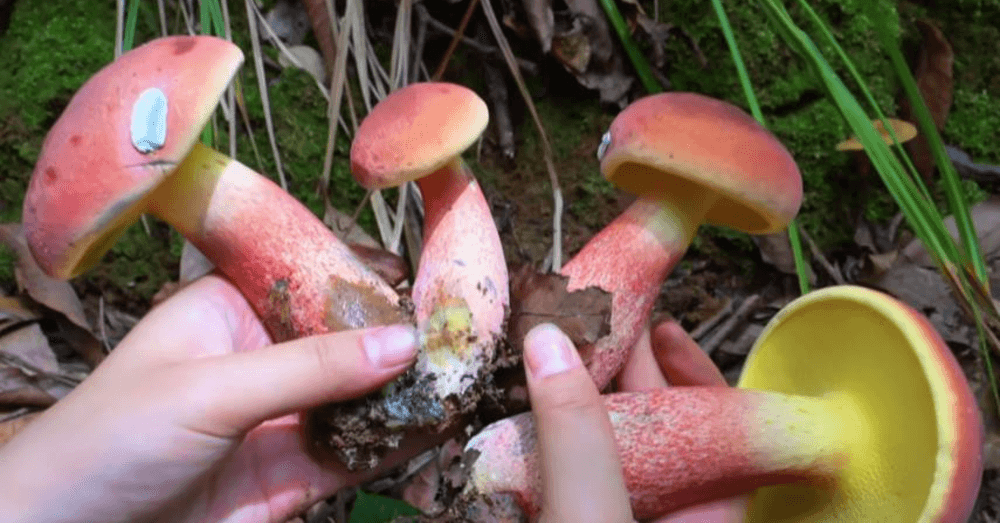
Imagine sitting down to a bowl of mushroom hot pot and, hours later, watching hundreds of inch-tall people march across your tablecloth. That’s exactly what happens to people who eat an undercooked version of a popular wild mushroom sold in China’s Yunnan Province. And the strangest part? Nearly everyone who eats it sees the same thing.
- Scientists are investigating Lanmaoa asiatica, a mushroom native to parts of Southeast Asia and China that causes consistent hallucinations when eaten undercooked.
- Hospital records show that 96 percent of patients affected by this mushroom report seeing crowds of “little people” or “elves,” often dancing, jumping, or marching around their environment.
- Chemical and genomic analyses performed on Lanmaoa asiatica have turned up no traces of any known psychoactive compounds, suggesting that something entirely new is waiting to be found.
A Dinner Staple With a Strange Side Effect
The mushroom is a popular food in China’s Yunnan Province, sold in markets, featured on restaurant menus, and known for its savory flavor. Locals call it Jian shou qing, which roughly translates to “turns blue in the hand,” a reference to its rapidly changing colors when touched. The mushroom is also served in household dishes during peak mushroom seasons between June and August.
Locals know the rules: cook it thoroughly, or you’ll pay the price. Colin Domnauer, a doctoral candidate in biology at the University of Utah, traveled to Yunnan to study Lanmaoa asiatica firsthand. Domnauer said the side effects of the mushroom seem “like very common knowledge in the culture” in Yunnan Province. At a mushroom hot pot restaurant, a server reportedly set a timer for 15 minutes and warned diners not to eat until the timer went off, or they might see little people.
Doctors in Yunnan Province are treating hundreds of cases a year of people having visions of small, pint-sized, elf-like figures crawling around and climbing up walls. The hallucinations can stick around for up to three days after a 12-to-24-hour onset, and they often result in hospitalizations.
Why Scientists Are Paying Attention
What makes this particular hallucinatory mushroom so unusual is that it causes the same kind of hallucinations in different people, across cultures. That consistency is practically unheard of in the world of psychoactive substances. Psilocybin, the active compound in typical magic mushrooms, produces wildly different experiences from person to person. Domnauer has determined that L. asiatica mushrooms do not contain psilocybin, and the main thing that sets them apart is that the experiences don’t vary greatly depending on the individual.
One professor in the region recalled eating stir-fried mushrooms and then lifting a tablecloth to find hundreds of tiny figures marching underneath like soldiers. The visions are often very realistic, three-dimensional figures said to be colorfully dressed, very mobile, and interacting with the physical world. They’ve been reported clinging to spoons, climbing furniture, and squeezing under doors.
This edible mushroom that makes you see tiny people has a history stretching well past modern Yunnan restaurants. Although Lanmaoa asiatica is a recent scientific name, its use may have much deeper ancient roots in Chinese culture. A prominent Daoist text from the 3rd century CE refers to a “flesh spirit mushroom” that, if consumed raw, allows one to “see a little person.”
Tracking the Mushroom Across Continents
The Yunnan cases aren’t isolated. A missionary first reported in 1936 that some bolete mushrooms consumed by natives in Papua New Guinea caused “madness.” The phenomenon was later described in more detail by anthropologist Marie Reay in the late 1950s, who reported that the mushrooms caused lilliputian hallucinations.
Indigenous communities in the Philippines’ remote Northern Cordillera were also collecting and consuming a wild mushroom which, according to local knowledge, occasionally brings on visions of little people, which they call the “ansisit.” The discovery of this Filipino mushroom’s identity surprised researchers: it was none other than Lanmaoa asiatica, the exact same species as in Yunnan.
The fact that the same peculiar hallucinations are independently reported across such distant cultures points to a shared chemical and neurological cause, rather than cultural fabrication or coincidence. Researchers in the 1960s had previously dismissed the Papua New Guinea accounts as ritualistic “acting out.” That conclusion makes more sense knowing the species wasn’t formally described until 2015.
A Chemical Mystery Still Waiting to Be Solved
Domnauer and his team are still trying to identify the chemical compound responsible for the hallucinations. Based on tests already conducted, it is most likely not related to any known psychedelic compounds. Whatever compound triggers these visions, it appears to be something science hasn’t catalogued yet.
The “trips” caused by this mushroom are unusually long, lasting from 12 to 24 hours. In some cases, patients remain in the hospital for up to a week. The trip can last so long that it’s impractical as a recreational drug, which is why no culture seems to use the mushroom intentionally as a psychedelic.
Understanding L. asiatica could help uncover the cause of spontaneous lilliputian hallucinations in people who haven’t consumed the mushroom. This is a rare condition: until 2021, since the first description in 1909, only 226 such cases not linked to mushrooms had been recorded. Researchers believe less than 5% of Earth’s fungal species have been described, so Lanmaoa asiatica could be just the beginning of a much bigger story. For now, though, the best advice for anyone visiting a Yunnan mushroom market is simple: cook it well and wait for the timer to go off.




More Stories
How a Star’s Gibbon Video Sparked a Wildlife Probe
How Jimothy the Raccoon Became an Online Sensation
How a Bus Numbered 666 Turned a Beach Trip Into Internet Gold